
Electromagnetic spectrum operations explained: EMSO, JEMSO, and EMBM
How DoD runs electromagnetic spectrum operations: JP 3-85, the EMS superiority strategy, JEMSO cells, EMBM, service EW units, and GAO's...
When the last Marine EA-6B Prowler squadron stood down in March 2019, the Marine Corps did not buy a replacement jamming aircraft. It chose a different model: spread electromagnetic warfare across many platforms, ground units, and software systems, and tie them together through the information warfighting function. Seven years on, that choice shows up in doctrine, in organizations such as the Marine Corps Information Command, and in a set of programs that are easy to lose track of because their names, budget lines, and program offices keep moving.
This article pulls together what the public record actually says. It draws on Marine Corps doctrine, Congressional Research Service reports, official program pages, Navy budget justification exhibits, and defense trade press. Where a program name or detail appears only in budget documents, that is stated. Where something is not publicly known, that is stated too. Dollar figures are left out on purpose: the budget exhibits cited here are public and readers who need the numbers should pull them directly from the source rather than from a secondhand summary.
The audience is program office staff, government engineers, and industry teams who need a working map of Marine Corps electromagnetic warfare (EW) modernization: what the Corps says it wants, what it is funding, what the programs are called on paper, and who buys them.
Joint doctrine consolidated the old JP 3-13.1, Electronic Warfare, and JP 6-01 into JP 3-85, Joint Electromagnetic Spectrum Operations, on 22 May 2020, according to the Air Force's summary of changes to AFDP 3-85. Current usage is electromagnetic warfare, with three divisions: electromagnetic attack (EA), electromagnetic support (ES), and electromagnetic protection (EP). Marine Corps documents have been catching up unevenly. The Marine Corps Systems Command (MCSC) office that was called Electronic Warfare Systems in a 2021 press release now appears on the MCSC website as Product Manager Electromagnetic Warfare Systems. Budget exhibits use both forms, sometimes on the same page. In this article the modern terms are used, except where a program's official name or a quoted document title still says "electronic."
Two other notes on sourcing. First, the Navy budget justification books that carry Marine Corps research, development, test, and evaluation (RDT&E) and Procurement, Marine Corps (PMC) lines are public, but they are large PDFs. The program element exhibits cited here were read from publicly posted copies of the President's Budget (PB) 2025 and PB 2027 R-2 exhibits. Second, much of Marine Corps signals intelligence and EW work is classified, and the budget exhibits themselves say so in places. One FY 2025 change summary notes that a signature management decrease "impacts YETI. Details are held at a higher classification." This article does not speculate past what the documents say.
The doctrinal foundation is the information warfighting function. According to MCDP 8, Information, it was formally established in January 2019 when Gen. Neller, the 37th Commandant, signed a Marine Corps Bulletin 5400. That decision made information a formal Marine Corps warfighting function.
MCDP 8 was signed on 29 June 2022 and announced in MARADMIN 332/22, which describes it as "the Marine Corps' capstone doctrine to describe the information warfighting function." The publication frames the function around four activities: generating, preserving, denying, and projecting information. EW fits in several of them. ES and spectrum sensing are part of generating information. EP and signature control are part of preserving it. EA is a form of denial. MCDP 8 explicitly lists actions to "selectively alter or suppress the visual, electromagnetic, and digital signatures emanating from friendly forces" as part of information denial, and it names signature management among passive denial methods.
MCDP 8 is a philosophy document, not a capability list. It does not name programs or set quantities. Its value for program and industry readers is that it explains why the Corps frames EW as part of a broader information fight rather than as a standalone aviation or intelligence mission.
Below the capstone level, MCWP 8-10, Information in Marine Corps Operations, dated 29 February 2024, places electromagnetic spectrum operations among the specialized information activities and points readers to reference and tactical publications for detailed procedures. It describes MEF Information Groups as providing specialized information units that may be organic to Fleet Marine Force units or available through reachback.
Force Design supplies the operational logic. According to the Congressional Research Service report R47614, U.S. Marine Corps Force Design Initiative, the Corps announced Force Design 2030 on 23 March 2020, issued annual updates, dropped "2030" from the name in early 2024, and released its latest update in October 2025. The guiding concepts are Littoral Operations in a Contested Environment and Expeditionary Advanced Base Operations (EABO). Small, dispersed units operating inside an adversary's weapons range live or die by their electromagnetic signature, which is why signature management and ground EW show up repeatedly in Force Design-related budget language.
A dedicated, public Marine Corps EW strategy document could not be located for this article. The public strategic picture is assembled from MCDP 8, Force Design documents, Marine Aviation Plans, and the program narratives in budget exhibits. If a dedicated Marine Corps EW or information maneuver strategy exists in a releasable form, it was not found in the sources reviewed here, and readers should not assume its contents. The closest thing to a public, program-level statement of intent is the language in the RDT&E exhibits discussed below.
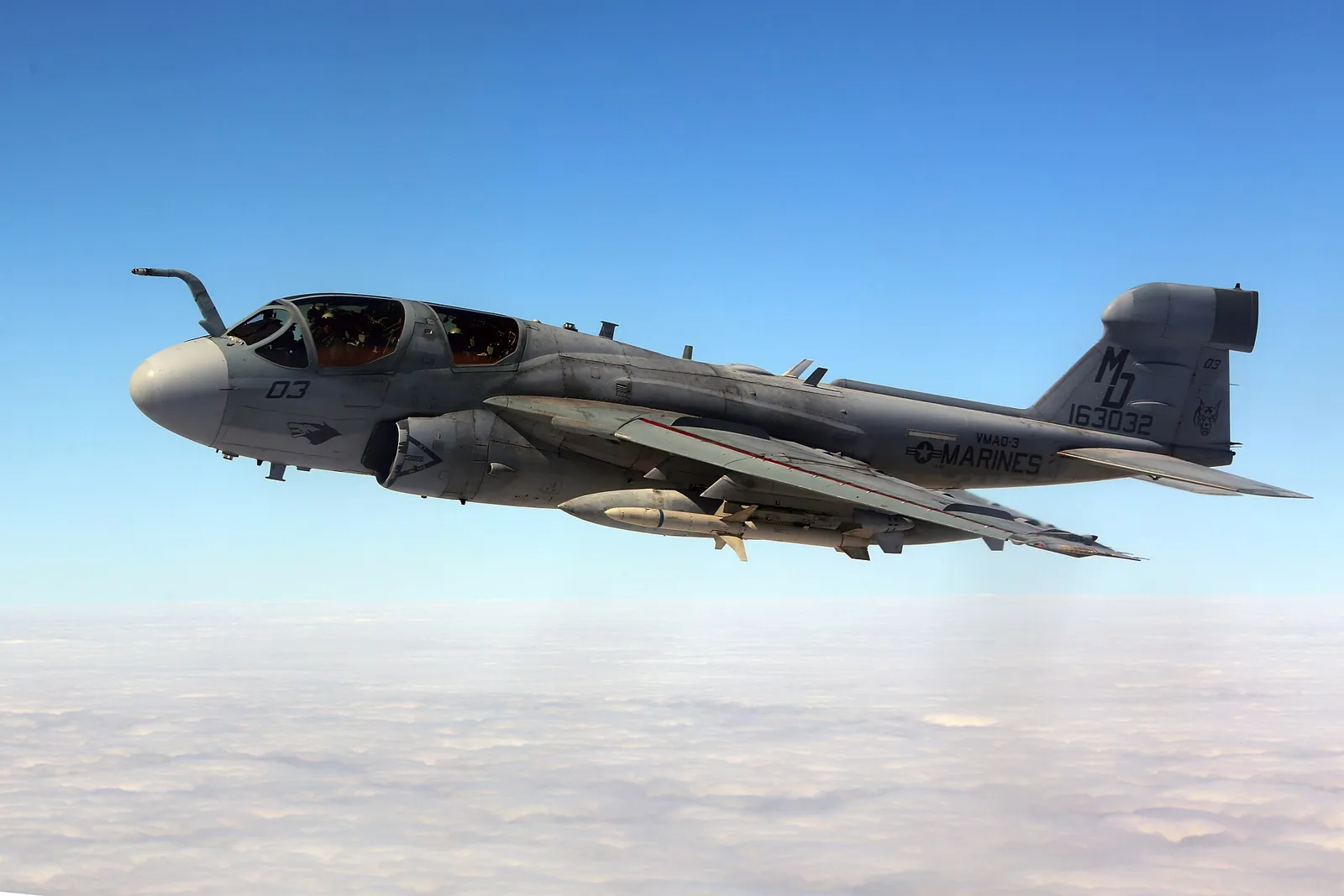
Marine Tactical Electronic Warfare Squadron 2 (VMAQ-2) flew its last EA-6B flights on 28 February 2019 and held its deactivation ceremony on 8 March 2019 at Marine Corps Air Station Cherry Point, USNI News reported. The Prowler had been the Corps' primary airborne EW platform for more than 40 years. VMAQ-2 had deployed six jets to Qatar in 2018 for its final combat missions. USNI News reported that the mission would pass to F-35B aircraft, the Intrepid Tiger II pod, unmanned aircraft and ground systems, and MAGTF EW sensors.
The Marine Air-Ground Task Force EW concept was laid out in the 2017 Marine Aviation Plan, which described a move "from a focus on the low-density/high-demand EA-6B, to a distributed, platform-agnostic strategy" in which every platform acts as a sensor, shooter, and sharer, including for EW, as quoted in coverage of WTI 1-18, the last Weapons and Tactics Instructor course to include the Prowler.
In practice that means three things:
The Marine Corps 2025 Aviation Plan, released in January 2025, continues the approach. It refers to integrating "the electronic warfare family of systems" across the UH-1Y, MV-22, and KC-130, and to work with the Marine Corps Spectrum Integration Lab on EW for unmanned systems.
An honest assessment of the public record: it shows the Corps fielding distributed EW capacity, but it does not show whether that capacity matches what the Prowler fleet provided in standoff and escort jamming. That comparison would require classified performance data, and no public source makes it with evidence.
NAVAIR's program page describes the AN/ALQ-231(V) Intrepid Tiger II (IT II) as "a precision, on-demand, external and internal carriage electronic warfare (EW) weapon system" that gives Marine aircraft organic, distributed, and networked airborne EW controllable from the cockpit or the ground. It emphasizes open architecture and rapid reprogrammability. The publicly listed variants are:
Naval News reported that the (V)4 first flew on 15 June 2021, that it uses a roll-on/roll-off rack-mounted payload controlled from a laptop in the cabin because external pods were unsuitable for the tiltrotor, and that the program planned fleet deliveries in FY 2023, initial operational capability by the end of FY 2024, and an inventory objective of 42 systems. The same report identifies the program office as PMA-234, NAVAIR's Airborne Electronic Attack Systems program office at Patuxent River, and quotes a PMA-234 "Marine Air-Ground Task Force EW Team Lead," which tells you how the office organizes the work. Public sources reviewed here do not confirm whether the (V)4 met those dates.
Some trade press refers to a KC-130J-specific (V)5 variant. NAVAIR's own page lists the KC-130J under (V)1. Where the two conflict, the NAVAIR page is the better reference.
IT II matters for ground programs too. Budget exhibits for the Spectrum Services Framework, described below, list sensor integration with IT II as a funded task, so the pod is treated as a sensor feeding a common spectrum picture, not just a jammer.
The Marine Corps flies the MQ-9A Reaper. The 2025 Aviation Plan states that the Corps operates 10 MQ-9A Block 5-20 aircraft and plans to field a total of 20 Block 5-25 aircraft. Two payloads have appeared publicly:
Beyond that, the public record is thin. The Marine Corps has not published detailed performance or employment data for MQ-9A ES or EA payloads, and statements attributed to senior leaders in the press have been deliberately vague. Treat any claim of specific MQ-9A EA capability with caution unless it comes from an official release.
The baseline ground EW capability for most of the force is the Multi-Function Electronic Warfare (MFEW) family of systems. The PB 2027 RDT&E exhibit for PE 0206313M says MFEW replaced the legacy Counter Radio Controlled Improvised Explosive Device (RCIED) Electronic Warfare system, known as CREW, in FY 2018, and that it "added significant additional force protection including Counter-Unmanned Aircraft System (CUAS) and rudimentary offensive EW capabilities." The PB 2025 exhibit adds that the first 300 MFEW Mounted systems began issue to the Fleet Marine Force in FY 2021, that another 286 were procured between FY 2022 and FY 2024, and that a final purchase of 107 was planned for 2024. It also notes MFEW traces to an urgent statement of need.
The planned successor is MEGFoS, and its name is a good example of why searching by acronym matters more than searching by expansion. Public documents use at least four versions:
Similarly, MFEW appears as "Multi-Function Electromagnetic Warfare" in the PB 2025 MEGFoS narrative and as "Multi-Function Electronic Warfare" elsewhere. Anyone doing market research or reading solicitations should search all variants.
The 2021 MCSC release said MEGFoS development began in 2020 and covered portable technologies for fixed sites, tactical vehicles, and dismounted operations. The PB 2025 exhibit gives the most detailed public description. It calls MEGFoS "the future of USMC ground electromagnetic warfare," intended to replace MFEW and give Marines the ability "to maneuver effectively in the electromagnetic spectrum (EMS) in a peer-to-peer environment." The exhibit says MEGFoS would:
The architecture is the part industry should care about most. The exhibit says MEGFoS is being developed to the C5ISR/EW Modular Open Suite of Standards (CMOSS) and the Sensor Open Systems Architecture (SOSA), "in coordination with the Army, Navy, and Air Force," to host "best of breed" capabilities and eliminate multiple proprietary "green boxes." The 2022 Pacific Defense announcement for MEGFoS static site systems likewise stressed SOSA alignment and CMOSS conformance.
The PB 2025 acquisition strategy section states that the MEGFoS Team Portable system was authorized for Middle Tier of Acquisition rapid prototyping in the third quarter of FY 2020, with prototyping planned to complete in the first quarter of FY 2024. On successful prototyping, the Corps planned to procure 49 Team Portable systems and use that design as the basis for the Dismounted and Mounted variants. The FY 2024 plans include completing a "MEGFoS Team Portable Operational Demonstration, in preparation for Rapid Prototyping outcome decision."
Procurement funding moved too. The exhibit's remarks state that "MEGFoS procurement transitions from Budget Line Item 6520 EOD Systems to Budget Line Item 4367 Electro Magnetic Spectrum Operations (EMSO) beginning FY 2024." The FY 2024 Procurement, Marine Corps justification book lists Electro Magnetic Spectrum Operations (EMSO) as BLI 4367 under budget activity 04, communications and electronics equipment.
This is the detail most readers will miss. In the PB 2027 exhibit for PE 0206313M, dated April 2026, the Project 2274 mission description no longer names MEGFoS. It describes MFEW as the current solution and says "the future operational solution will be fulfilled by a future system" built on CMOSS and SOSA. The FY 2027 plans focus on MFEW modernization for mounted and dismounted use, an "own force sensing" capability for RF spectrum monitoring, a "Mounted Chassis Variant 1," and integration of CMOSS payload devices. The exhibit shows no Project 2274 RDT&E funding in FY 2026, with work resuming in FY 2027.
The MEGFoS name survives in the PB 2027 exhibit only in the other program funding summary, as the line "PMC/4367: Electro Magnetic Spectrum Operations (EMSO) - MEGFoS," and in the historical remarks about its Middle Tier rapid prototyping funding. The exhibit does not explain the change. Public sources reviewed for this article do not say whether MEGFoS was renamed, restructured, or folded into an MFEW modernization effort, so that question remains open. For now, the safest reading is that the ground EW requirement and the CMOSS/SOSA approach continue, and the MEGFoS label is fading from the RDT&E narrative.
The PB 2025 R-3 cost analysis for MEGFoS lists performing activities including MCSC at Quantico, Naval Information Warfare Center (NIWC) Atlantic in Charleston, Johns Hopkins University Applied Physics Laboratory in Laurel, Maryland, and Naval Surface Warfare Center Crane in Indiana, alongside commercial contracts. For companies, that means the government labs are major integrators and test partners, and teaming with or supporting them is often as relevant as pursuing a prime award.
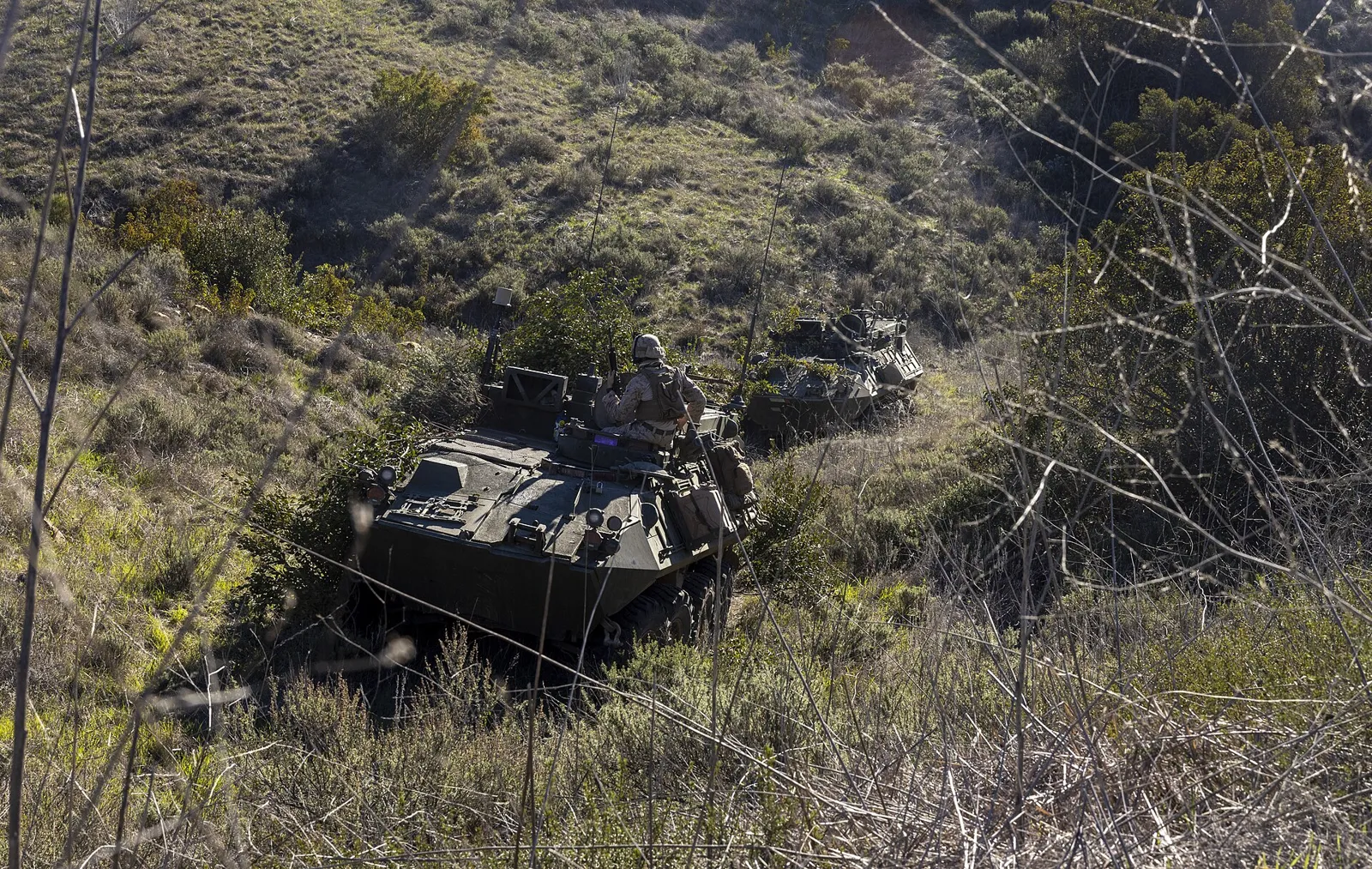
The Marine Corps' high-power ground EA capability sits with the Radio Battalions, which combine signals intelligence and EW. CRS report R45919, Ground Electronic Warfare (2019) describes them that way and notes the older Mobile Electronic Warfare Support System (MEWSS), twelve modified light armored vehicles procured in 1987. Current budget exhibits refer to the Light Armored Vehicle-Electronic Warfare (LAV-EW) as one of the platforms receiving modern EW equipment.
The 2016 MCSC announcement introduced the Communication Emitter Sensing and Attack System II (CESAS II), which detects, denies, and disrupts threat communications across HF, VHF, and UHF. It was integrated on the Humvee at 670 pounds, down from 1,300, with a 180-pound man-portable configuration, and was described as enhancing "the radio battalion's ability to support and execute the MAGTF Information Warfare plan." CRS reported that CESAS II reached initial operational capability in July 2016.
Note the name drift again. MCSC's 2016 release says "Attack System." Budget exhibits say "Communication Emitter Sensing and Attacking System (CESAS)." The PB 2025 exhibit for PE 0206625M, USMC Intelligence/Electronics Warfare Sys, describes CESAS as a high-power ground EA system employed by Radio Battalion and Marine Forces Special Operations Command operators. It says an increase to the CESAS II family of systems Authorized Acquisition Objective, tied to Force Design, equips SIGINT/EW teams in the infantry battalion, Radio Reconnaissance Teams, LAV-EW, MARFORSOC, and the supporting establishment. That same exhibit describes several related efforts that appear mainly in budget documents:
The PB 2027 exhibit for PE 0206625M reports a structural change: the Tactical Signals Intelligence Collection System (TSCS) family of systems "incorporates the TSCS and COMMUNICATION EMITTER SENSING and ATTACKING SYSTEM (CESAS) programs into a single program," and the decrease in CESAS RDT&E from FY 2026 to FY 2027 "reflects the consolidation of the TSCS and CESAS programs." The exhibit says realignment of CESAS funding into TSCS will continue to support CESAS Enhanced EW through the future years defense program. TSCS itself, per the PB 2025 exhibit, is "the primary program of record for the USMC SIGINT/EW community," combining earlier programs for radio reconnaissance and team portable collection, with platform integration kits for tactical vehicles and the MV-22 to provide precision geolocation.
For anyone tracking CESAS, this means future work may be described under TSCS rather than CESAS. In procurement, the PB 2025 exhibit shows CESAS and TSCS as sub-lines of PMC BLI 4747, Intelligence Support Equipment.
Organizationally, the Corps has stood up MEF Information Groups at each MEF, and the 2022 JED article notes an Electromagnetic Spectrum Operations Cell inside MEF information command centers. At the service level, the Corps activated the Marine Corps Information Command (MCIC) on 17 January 2023 at Fort George G. Meade. The activation release says MCIC comprises a headquarters, the Marine Cryptologic Office, the Marine Corps Information Operations Center (MCIOC), and the Marine Cryptologic Support Battalion, under a commander who also leads Marine Corps Forces Cyberspace Command and Marine Corps Forces Space Command. The intent, as then-Deputy Commandant for Information Lt. Gen. Matthew Glavy described it to DefenseScoop, was to link forward forces to joint, national, space, and cyber capabilities and streamline authorities. By 2024, MCIC staff described working through command relationships across Cyber Command, Space Command, and NSA as "a learning point."
The public record does not describe in detail how MCIC directs tactical EW. Radio Battalions remain the operators of ground EA systems such as CESAS, and MCIOC is the named user of signature management tools, as described next.
A distributed EW force needs a common picture. The Corps' answer in budget documents is the Spectrum Services Framework (SSF). The PB 2027 exhibit describes it as "a software-only, hardware agnostic, agile development program" hosted on the Marine Corps Enterprise Network at the Secret level, which supports ingestion, management, and dissemination of spectrum data with analytic and visualization services for situational awareness, decision support, training, and command and control of EMSO. It currently ingests data from national-level databases and is prioritizing integration with organic Marine sensors. The exhibit also says the legacy Systems Planning Engineering Evaluation Device (SPEED) communications planning software will be consolidated into SSF in FY 2027.
The PB 2025 exhibit lists SSF sensor integration tasks with Intrepid Tiger II, MEGFoS, MFEW, and the CESAS family of systems, plus interfaces with joint electromagnetic battle management and other systems. That list is the clearest public evidence of how the Corps intends its airborne and ground EW systems to share data.
SSF moved between program elements. It was funded in PE 0206625M (intelligence and EW) and, per the PB 2027 exhibits, transitions to PE 0206313M, Project 2275, Marine Corps Tactical Radio Systems, in FY 2027. If you tracked SSF under the intelligence line, look for it under communications now.
Signature management is the EP side of Force Design. In PE 0206313M, Project 3772, Information Related Capabilities, the PB 2025 and PB 2027 exhibits describe SIGMAN as a Force Design program to be used by an MCIOC SIGMAN platoon to help commanders understand their own forces' electromagnetic signatures and disrupt adversary units. The increments described are:
The PB 2025 exhibit says SIGMAN will procure production articles through a lead systems integrator and the Army C5ISR program office, which is worth noting for companies already working with Army spectrum programs. The same exhibits mention YETI and, in PB 2027, Smoke Screen, with YETI details held at a higher classification. Beyond the names, nothing public describes those efforts.
The most visible EA systems in the Marine Corps today may be counter-drone systems. The Marine Air Defense Integrated System (MADIS) and the Light MADIS (L-MADIS) are managed under PEO Land Systems, whose program overview lists PM Ground Based Air Defense and describes L-MADIS as delivering non-kinetic counter-UAS capability.
According to The War Zone, the components include an electro-optical turret, an RPS-42 radar, a Skyview MP passive RF detection system, and a Modi II jammer for EA against drone control and data links, plus Stinger missiles and a 30mm cannon on the JLTV-based MADIS. L-MADIS splits sensing and jamming across two Polaris MRZR vehicles. The same report cites a stated need for 21 L-MADIS and 190 MADIS systems, with MADIS fielding beginning in early 2025. CRS R45919 noted that 28 MADIS systems were requested for FY 2020.
The Modi II backpack and MVPA II vehicle systems also appear in the 2024 MCSC PM TCE industry brief program list and the 2022 JED article as fielded ground EW equipment, which shows how counter-UAS and general ground EW overlap. Budget language for the MFEW modernization line in PB 2027 is driven largely by counter-UAS and counter-RCIED threats.
In budget terms, MADIS sits under Ground Based Air Defense, listed in the FY 2024 PMC book as BLI 3006 under guided missiles and equipment. It is not under the EMSO line, even though it delivers EA. Industry teams with RF detection or jamming products should track both.
The table below lists the EW-related names discussed above as they appear in the cited budget exhibits, with notes on where they show up elsewhere. "Budget only" means no separate official program page or press release was found for this article.
| Name as written | Where it appears | Notes |
|---|---|---|
| Marine Electromagnetic Warfare Ground Family of Systems (MEGFoS) | RDT&E PE 0206313M, Project 2274 (Command & Control Warfare Sys); PMC BLI 4367 EMSO | Also called MAGTF Electronic Warfare Ground Family of Systems in MCSC press. Name absent from PB 2027 Project 2274 narrative. |
| Multi-Function Electronic Warfare (MFEW) | PE 0206313M, Project 2274 | Also written Multi-Function Electromagnetic Warfare. PB 2027 refers to MFEW modernization. |
| Communication Emitter Sensing and Attacking System (CESAS) / CESAS II FoS | PE 0206625M, Project 2272; PMC BLI 4747 sub-line | MCSC 2016 release says Attack System. Consolidating into TSCS per PB 2027. |
| Tactical Signals Intelligence (SIGINT) Collection System (TSCS) | PE 0206625M, Project 2272; PMC BLI 4747 sub-line | Described as the primary SIGINT/EW program of record. |
| Advanced Electronic Warfare Digital Payload (AEWDP) | PE 0206625M, under CESAS | Budget only. |
| Constructive Electromagnetic Operating Environment System (CEMOES) | PE 0206625M, under CESAS | Budget only. |
| Spectrum Services Framework (SSF) | PE 0206625M through FY 2026; PE 0206313M, Project 2275 from FY 2027 | Budget only in the sources reviewed. |
| Signature Management (SIGMAN), including SVPT and CRIT | PE 0206313M, Project 3772 (Information Related Capabilities) | Budget only in the sources reviewed. YETI details classified. |
| Electro Magnetic Spectrum Operations (EMSO) | PMC BLI 4367 | Procurement line that now carries MEGFoS. |
| AN/ALQ-231 Intrepid Tiger II (V)1, (V)3, (V)4 | NAVAIR, PMA-234 | Official NAVAIR program page. |
The PE titles themselves are worth copying exactly when searching budget databases: PE 0206313M is Marine Corps Comms Systems and PE 0206625M is USMC Intelligence/Electronics Warfare Sys. Both are in the RDT&E, Navy appropriation (1319), budget activity 7, operational systems development. The Intrepid Tiger II budget lines were not reviewed for this article, so its program element is not listed here.
Marine Corps EW acquisition is split across several organizations, and the split follows the platform more than the mission:
The budget exhibits show recurring patterns that matter for planning:
The 2024 PM TCE brief listed industry interest areas including modular and scalable designs, maintenance at the forward edge, low probability of intercept and detection communications, naval interoperability, multi-orbit satellite terminals, and artificial intelligence. It also listed a planned PM TCE program support contract for the first quarter of FY 2025. Opportunities announced in a briefing are plans, not awards, so confirm status on SAM.gov before acting on them.
Several open questions will shape Marine Corps EW over the next few budget cycles. All of them can be tracked through public sources:
The Marine Corps replaced the Prowler with a distributed model, and the public record supports that it is building one: Intrepid Tiger II on multiple aircraft, MFEW and its successor on the ground, CESAS and TSCS with the Radio Battalions, MADIS and L-MADIS for counter-UAS, SIGMAN for signature control, and SSF to pull the data together. The doctrine is settled at the capstone level in MCDP 8 and Force Design. What is less settled is the program structure. Names change between documents, programs consolidate, and funding moves across program elements and budget lines.
For government and industry readers, the practical lesson is to work from primary documents. The budget exhibits are public, specific, and more current than most press coverage, and they often state things no press release does, such as the shift of MEGFoS procurement to the EMSO line or the merger of CESAS into TSCS. What they do not provide is performance data or operational assessments. Those remain classified, and any public claim about how well Marine EW performs against a peer threat should be read with that limit in mind.
How DoD runs electromagnetic spectrum operations: JP 3-85, the EMS superiority strategy, JEMSO cells, EMBM, service EW units, and GAO's...
How GNSS jamming, spoofing, and meaconing work, what Ukraine, the Baltic, and the Middle East show, and how militaries, regulators, and engineers...

How DoD is building assured PNT: GPS and M-code status per GAO, Army MAPS and DAPS, LEO PNT, eLoran, magnetic, vision, quantum sensing, and...