
Electromagnetic spectrum operations explained: EMSO, JEMSO, and EMBM
How DoD runs electromagnetic spectrum operations: JP 3-85, the EMS superiority strategy, JEMSO cells, EMBM, service EW units, and GAO's...
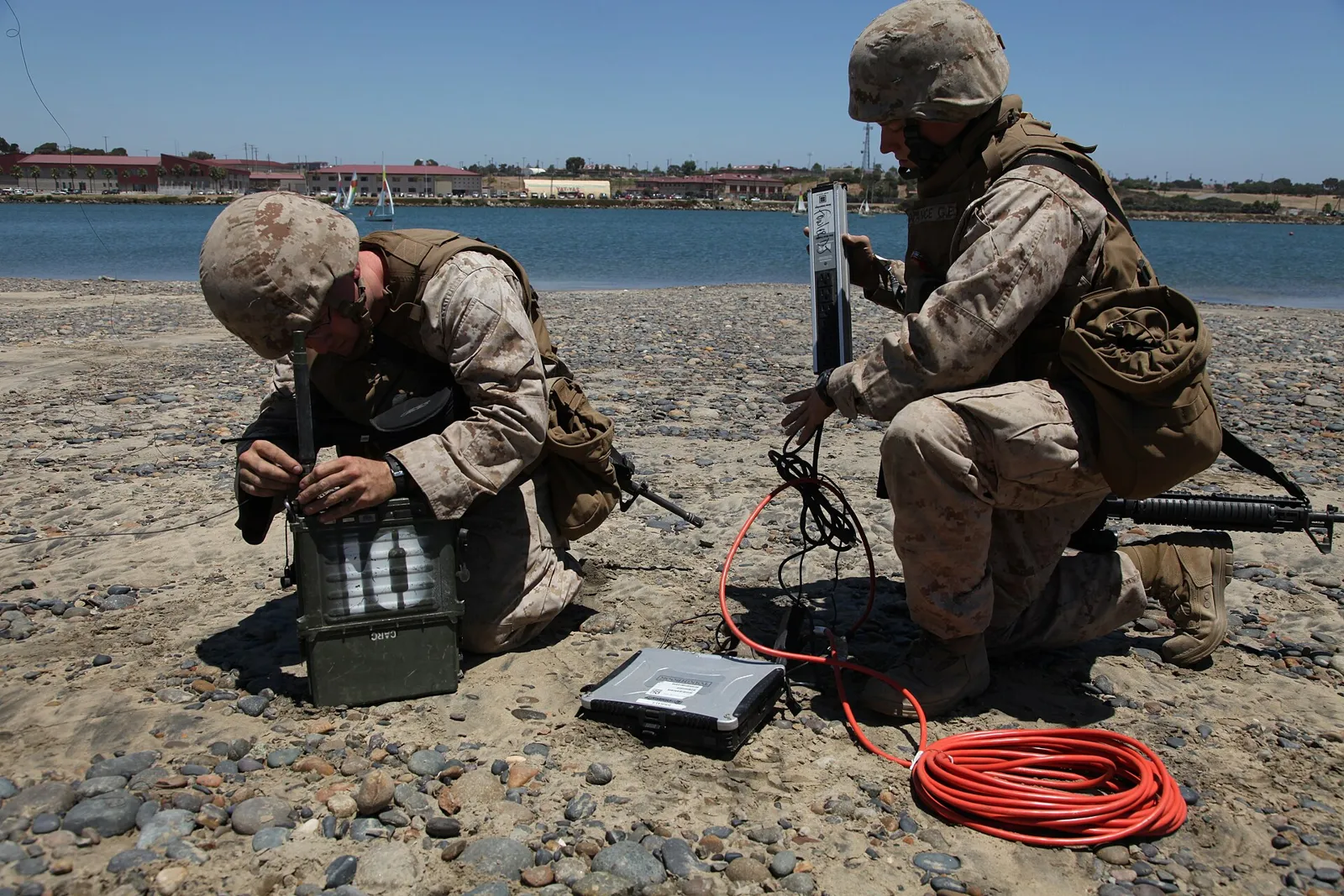
Every radio, radar, datalink, satellite terminal, cellphone, and generator in a formation is telling someone where it is. In a counterinsurgency fight against an adversary with little ability to sense the electromagnetic spectrum, that did not matter much. Against an opponent with modern electromagnetic support (ES) receivers, unmanned aircraft, long-range fires, and access to space-based sensing, it matters more than almost anything else a unit does in the field. A command post that can be found can be hit, and the fighting in Ukraine has shown how short the gap between those two events can be.
Signature management is the discipline of controlling what a force gives away. Emissions control, or EMCON, is the oldest and most familiar part of it: the deliberate, planned restriction of electromagnetic emitters to deny an adversary detection, identification, and location. Neither idea is new. Navies have practiced radio silence since radio existed, and armies have camouflaged positions for far longer. What has changed is the density and reach of the sensors aimed at US forces, and the degree to which two decades of operating in uncontested spectrum let the habits of discipline fade.
What follows draws only on open, unclassified writing from the Navy, Marine Corps, and Army, plus public reporting. Specific EMCON condition tables, threat system parameters, and US capability details beyond what the services have published are not covered, and where public sources are thin, the article says so.
A signature is anything an adversary sensor can detect and use to find, identify, or characterize a unit. Practitioners usually break signatures into categories by the physics involved, though the categories overlap and an adversary will fuse them.
The RF signature is the one that gets the most attention, and for good reason. Any intentional transmitter, whether a VHF combat net radio, an HF link, a tactical satellite terminal, a line-of-sight radio relay, a counterfire radar, a Wi-Fi access point, or a personal cellphone, radiates energy that travels well beyond the receiver it was meant for. An adversary receiver that hears that energy can learn several things from it:
The last item is easy to overlook. Even fully encrypted traffic leaks information through its pattern. Traffic analysis reads who is talking to whom, how often, and how much. Encryption protects content. It does nothing to hide the existence, location, or rhythm of the transmitter.
RF is not the only problem, and fixing it alone will not save a position. Generators, vehicle engines, heaters, and people all produce heat that shows up clearly to thermal sensors, including those on small commercial drones. Visual signatures include vehicle tracks, antenna masts, satellite dishes, vehicle concentrations, trash, and foot traffic in and out of a building. Acoustic signatures come mostly from generators and vehicles.
Australian Army writing makes the point well. Major JR Jenkins of the 3rd Combat Signal Regiment argued in an article for The Cove that traditional RF-only EMCON is not enough for command and control node survivability, and that brigades need a broader signature management approach that covers physical, audible, and thermal signatures as well. Jenkins identified thermal management as the hardest control measure, and noted a trap that anyone who has worked with thermal sensors will recognize: thermal concealment can create a cold spot that stands out against the surrounding environment just as clearly as a hot one.
A final category is less about physics and more about habits. Units that transmit at the same times each day, that send a logistics status report every evening at the same hour, or that set up command posts in the same configuration every time are creating a pattern an adversary can learn. Several of the service authors cited below make the same recommendation in different words: avoid predictability. That applies to communication windows, antenna placement, and movement as much as to any single transmitter.
The logic is straightforward. Modern long-range fires are precise, but precision is only useful if the target can be located. Radio emissions are one of the fastest ways to locate a target that is otherwise concealed, because a transmitter announces itself across kilometers of terrain regardless of camouflage netting or tree cover.
Direction finding (DF) measures the angle of arrival of a signal at a receiver. One receiver produces a line of bearing. Two or more receivers at different locations produce intersecting lines, and the intersection gives an estimated position. Other techniques, such as measuring time difference of arrival or frequency difference of arrival across multiple receivers, can also produce a location. Accuracy depends on geometry, receiver quality, signal characteristics, terrain, and how long the emitter stays on the air. The longer and louder a transmission, the easier the problem becomes.
Receivers can be on the ground, on aircraft, on unmanned aircraft, or in space. Airborne receivers matter because altitude extends line of sight, which lets a receiver hear VHF and UHF emitters that a ground station behind a ridge never would. Ukrainian officers described this threat directly at a 2019 Association of Old Crows symposium, as reported by Army Times: Russian drones carried direction-finding equipment to track Ukrainian positions on the ground for targeting. The same reporting quoted Col. Ivan Pavlenko of Ukraine's Joint Staff describing how Russian forces would blind Ukrainian radar systems and then shell Ukrainian forces.
Space-based RF geolocation used to be the exclusive domain of national intelligence systems, and the details of those systems remain classified. What has changed is that commercial companies now do some of it openly. Via Satellite reported in 2019 that HawkEye 360 had commissioned its three Pathfinder satellites and begun geolocating RF signals, including VHF maritime channels, AIS, emergency beacons, and marine radar. The significance for signature management is not any one company. It is the fact that RF geolocation from orbit is now a commercial product, which means any adversary with money or a willing partner has some access to it. Planners should assume that emitters on the ground and at sea can be observed from above, and should not assume they know the revisit times or sensitivity of every system that might be looking.
Targeting doctrine describes a cycle: find a target, fix its location with enough accuracy to engage, finish it with fires or maneuver, and assess the result. An emitter shortens the find and fix steps, sometimes dramatically. ES sensors cue an unmanned aircraft. The aircraft confirms the target visually or thermally. Fires follow. Army writing on command posts has emphasized the speed. In a 2020 article on Army.mil, Maj. Jeremy Horton and Col. Ted Thomas of the Mission Command Center of Excellence described adversary signals intelligence as the most dangerous threat to a command post because it lets the enemy detect command post signatures rapidly, and wrote that detected positions can be targeted within minutes by enemy indirect fire. Writing about Ukraine in 2024, Thomas Withington of Armada International reported that Russian forces can convert detected communications signals into artillery targets within minutes.
The emitter does not need to be military. In January 2023, after a Ukrainian strike on a temporary barracks in Makiivka, the Russian Ministry of Defense publicly blamed "the illegal mass use of mobile phones by servicemen," saying this allowed the enemy to "track and determine the coordinates of the soldiers' location," according to Euronews. Russia put its own death toll at 89, while Ukraine claimed far higher numbers. Whether phones were the whole story is not something open sources can settle, and the Russian statement may have served to shift blame. The point stands regardless: a ministry of defense told the world that personal phones got its soldiers killed.
Marine Maj. Brian Kerg, writing in Proceedings in December 2020 under the title "To Be Detected Is to Be Killed," pointed to the 2020 Armenia-Azerbaijan war, where Armenian mechanized forces were detected and destroyed by Azerbaijani drones and loitering munitions. His argument was that the expeditionary advanced base concept depends on signature management, because a small, distributed force that can be found will not survive long enough to matter.
Chief Warrant Officer Robert Labrenz defined EMCON in a June 2023 Proceedings article as "the selective and controlled use of electromagnetic" emitters "to optimize command-and-control capabilities while minimizing detection by enemy sensors." That definition captures the trade at the center of the whole subject. EMCON is not simply turning things off. It is deciding which emitters are worth the risk at a given moment, and accepting reduced capability in exchange for reduced exposure.
The most famous case of EMCON working is also a case of EMCON paired with deception. Historian R.J. Hanyok, in an article republished by Military Times in 2024, described how Vice Admiral Chuichi Nagumo ordered that all transmissions among the ships of the Pearl Harbor strike force were strictly forbidden, and enforced it by disabling or removing transmitters. At the same time, Japanese shore stations kept up radio traffic using operators whose sending styles American analysts recognized, so that direction finding on familiar call signs would suggest the carriers were still in home waters. American radio intelligence at the time relied heavily on direction finding and traffic analysis. A change in Japanese addressing procedures in November 1941 made that analysis far harder, and by early December US officers believed the carriers were near Japan.
Two lessons from that episode still hold. First, silence alone creates a gap, and a sudden gap is itself a signal. Second, a force that controls its own emissions while feeding the adversary a believable false picture is far more effective than one that only goes quiet.
During the Cold War, the US Navy trained to operate against a Soviet ocean surveillance system that included signals intelligence collection. Lt. (j.g.) Zachary Hoyt, in a July 2017 Proceedings article titled "Get Used to EMCON," described that era as one of survival through concealment and nearly silent operations. He argued that in the roughly 25 years after the Cold War, the absence of a peer competitor and the arrival of constant high-bandwidth connectivity eroded the habit. In his words, EMCON measures "have long been skills to be demonstrated during certification yet rarely employed during deployments." He described Sixth Fleet's Silent Echo exercises as an effort to reverse that, built around reducing the probability of detection, with ships defaulting to silence and activating systems only when needed, and around electromagnetic agility, meaning the ability to keep operating in a communications-denied environment and to vary emission patterns so an adversary cannot predict them.
Lt. (j.g.) Daniel Stefanus made a related case in "Embracing the Dark Battle" in Proceedings in April 2017. He argued that the surface force functions well with many sensors and networks and poorly with few, and proposed a tactical rhythm he summarized as EMCON, illuminate, fire, return to EMCON, withdraw, and reload. He also called for more EW training in officer and enlisted pipelines and for an EW weapons and tactics instructor program.
Navy and joint EMCON conditions are defined in instructions and unit procedures, and the specific condition tables are not something to reconstruct from open writing. Publicly, the concept is a graduated scale running from full emissions to complete silence, with intermediate conditions that authorize specific emitters for specific purposes. Labrenz described four broad approaches that illustrate the range:
He paired those approaches with practical methods, including flashing light with modern text conversion, text-only messaging that favors brevity over graphics, discrete communication windows similar to submarine practice, mission command so subordinates can act without constant contact, and uncrewed scouts to sense the battlespace without putting crewed platforms at risk. Lt. Patrick Goldman, writing in Proceedings in August 2022, proposed going further, with total emissions silence on leaving friendly waters and satellite communication checks at random intervals so the check-ins themselves do not form a pattern.
The Marine Corps' shift under Force Design toward small, distributed units operating inside an adversary's weapons engagement zone made signature management a central concern rather than a niche skill. Expeditionary Advanced Base Operations envisions small teams holding key maritime terrain, sensing, and striking. That concept only works if those teams can survive, and survival depends heavily on not being found.
The service formalized some of its thinking in a series of handbooks published by the Deputy Commandant for Information and the Marine Corps Information Operations Center. MARADMIN 342/21, released in July 2021, announced the Signature Management Planning Handbook, intended to "provide guidance on how to plan SIGMAN in support of Fleet Marine Force operations" and to serve as a primer on the ideas, logic, context, and terminology of signature management. The message described it as the first of three planned handbooks, with later volumes covering signature assessments and countermeasures.
The second, announced in MARADMIN 238/22 in May 2022, was the Signature Management Own Force Signature Assessment (OFSA) Handbook, meant to "provide guidance on how to plan and execute a SIGMAN assessment in support of Fleet Marine Force operations." Both messages were candid that the material was a starting point. The OFSA message stated that the content was "baseline and not definitive" and should not be considered fully formed methodology or doctrine. That candor is worth noting. The Marine Corps published its signature management thinking as something to be tested, not as settled doctrine, and units should read it that way.
Some of the most practical public writing on the subject comes from Marine Corps Gazette authors working at the small-unit and communications level.
CWO3 Patrick Fahey, in an April 2021 Gazette article on EABO communications training, laid out a set of recommended standard operating procedure changes. They included terrain masking, random communication windows, brevity codes, minimum transmit power, Iridium phones instead of cellphones, remote antenna sites "at least one kilometer away from the combat operations center," decoy devices "that emulate friendly signatures or emit false signals," and "an emissions control primary, alternate, contingency, and emergency (PACE) plan." He also flagged a structural problem: during I MEF and III MEF exercises from 2018 to 2020, average bandwidth use ran 30 to 60 Mbps, while tactical satellite links to the Defense Information Systems Agency normally provided 8 Mbps or less. A force that trains on commercial fiber and then deploys on tactical links will find out at the worst possible time that its habits do not fit its pipes, and the pressure to push more data through more emitters works directly against signature discipline.
Capt. Luke Klena, in a May 2021 Gazette article on technical signature management for small units, made a point that should anchor any unit's approach: "The duration of a transmission is directly related to the probability of detection of the signal." His three primary techniques were reducing communication time, adjusting transmit power, and masking emissions through terrain and field-expedient directional antennas such as long wire, sloping vee, and resonant arrays. He also noted that context matters: if there is no threat of detection, leaders have more freedom in how they communicate. Signature management is threat-driven, not a blanket rule to stay silent no matter what.
For the Army, signature management has become largely a conversation about command posts. Large, static headquarters with dozens of vehicles, generators, and antenna farms were tolerable in Iraq and Afghanistan. Against a peer adversary with DF, drones, and long-range fires, they are targets.
Horton and Thomas opened their 2020 article with a scenario in which a division main command post is detected by an unmanned aircraft and destroyed by a ballistic missile minutes later. They described the threat as spanning physical, electromagnetic, thermal, and acoustic signatures, and argued that technical fixes, operational practice, and training all had to change together. They pointed to the Command Post Integrated Infrastructure effort as one way to reduce footprint and support dispersed operations.
Army doctrine has picked up the theme. FM 3-0, the Army's 2022 operations manual, states, as quoted by CRFS: "Because Army forces employ an increasing number of capabilities that emit electromagnetic radiation that enemies can target, leaders must apply emission control measures, balancing the risks to the force with the risks to the mission." The final clause is the important one. EMCON is a risk decision that belongs to commanders, not a technical setting that belongs only to the signal officer.
The acquisition community has said much the same. In a 2023 DefenseScoop report, Mark Kitz, then the Army's program executive officer for Command, Control, Communications-Tactical, said, "We have got to build a network that is hard to find, that it's hard to target," and described commanders deciding which parts of the network to enable and which to obscure. Col. Shermoan Daiyaan, project manager for tactical radios, said units were "starting to collect what the signatures look like" at combat training centers. Another program official noted that millimeter wave and free space optical links have much reduced signatures and are directional. The report also said the Army planned to field a Spectrum Situational Awareness System to help units see their own electromagnetic signatures.
More recently, Justin Lynch argued in War on the Rocks in May 2026 that the Army still needs to rethink command post design, contrasting the large "TOC Mahal" configurations seen at training rotations with what survives in Ukraine.
Capt. Ryan McGovern, who served with the 2nd Armored Brigade Combat Team, 1st Armored Division, published a useful April 2025 Army.mil article on developing an emissions control SOP. He framed the guidance with an acronym built from the word itself:
McGovern described radio frequency direction finding as "the most acute EW threat to tactical ground maneuver" and pointed to historical precedent: during the 1988 Return of Forces to Germany exercise, the 1st Cavalry Division moved 4,534 vehicles under radio listening silence. That example is worth repeating to anyone who thinks maneuver without constant voice traffic is impossible. It was done routinely by a generation that trained for it.
The techniques below are drawn from the service writing above and from basic radio physics. None of them is exotic. Most of them cost time, convenience, or capability, which is why they tend to get dropped when nobody is enforcing them.
The simplest and most effective measure is to stay off the air. Every message not sent is a transmission that cannot be intercepted. Preplanned messages, brevity codes, formatted reports, and scheduled communication windows all reduce air time. So does mission command, because subordinates who understand intent need fewer updates and fewer permissions. Klena recommended that units start by logging how often and how long they transmit, so they have a baseline to improve against.
Burst transmission takes the idea further by compressing a message and sending it in a very short transmission. Short transmissions give a direction-finding system less time to acquire, measure, and refine a bearing, though they do not make an emitter invisible.
Radio energy spreads out as it travels, so a transmitter at lower power is detectable over a smaller area. If two stations are a few kilometers apart, transmitting at maximum power broadcasts the signal far beyond where it needs to go. Klena noted a practical limit: the AN/PRC-152 offers only a few discrete power settings, which leaves gaps between what a link needs and what the radio can deliver. Still, defaulting to the lowest setting that closes the link is a habit any operator can adopt today.
Omnidirectional antennas radiate in all directions, including toward the enemy. Directional antennas concentrate energy along the path to the intended receiver and reduce it elsewhere. Field-expedient directional antennas have been taught to radio operators for generations, and Klena specifically recommended them. Terrain masking does the same thing with the earth itself: placing a hill, building, or tree line between the emitter and the likely threat direction blocks or weakens the signal along that axis. At higher frequencies, line-of-sight links such as millimeter wave and free space optics offer very narrow beams, which is why Army program officials have pointed to them as low-signature options.
If an adversary can locate an emitter, the next best thing to not emitting is ensuring the emitter is not where the commander and staff are. Remoting antennas, by cable or by relay, moves the RF signature away from the command post. Fahey recommended remote antenna sites at least a kilometer from the combat operations center. Withington's reporting from Ukraine described the same principle: relocate antennas and radios at a safe distance so that if the emitters are geolocated and struck, the command post itself survives. Remoting has costs, including cable runs, security for the remote site, and setup time, but it changes the outcome of an enemy fix from a decapitation strike to a lost antenna.
Low probability of intercept (LPI) and low probability of detection (LPD) waveforms try to make a signal hard to notice or hard to characterize. Common approaches include spreading the signal across a wide bandwidth so its power at any one frequency sits near or below the noise floor, frequency hopping across many channels, and adapting power and frequency to the link. Kerg pointed to HF radios that vary power and frequency, and to direct sequence and frequency-hopping spread spectrum, as examples.
Two cautions apply. First, LPI and LPD are relative terms. A waveform is harder to detect against a specific receiver at a specific range, not invisible to everything. Second, the actual performance of fielded US waveforms against specific threat receivers is not public, and claims about it in open sources should be read skeptically. The honest planning assumption is that LPI and LPD buy margin, not immunity.
In some environments, the least conspicuous signal is one that looks like everyone else's. Labrenz described ships using only commercial emitters that are indistinguishable from civilian shipping. Jenkins discussed using civilian communication systems and local networks so military traffic blends into commercial traffic, and using existing structures in urban areas to conceal vehicles and systems. Blending has limits, since commercial networks can be monitored and a commercial terminal in an odd place can stand out, but it turns the adversary's problem into sorting a signal from a crowd.
Decoys give an adversary something to find. Fahey recommended decoy devices that emulate friendly signatures or emit false signals. Withington described Ukrainian use of fake satellite antennas made from household items such as buckets or pots, painted white. Kerg described unmanned swarms transmitting false command and control signals. The Pearl Harbor case is the historical model: the Japanese strike force went silent while shore stations generated believable traffic elsewhere. Decoys work best when they are part of a coherent false picture that matches what the adversary expects to see, and when they cost the enemy time and munitions.
Primary, alternate, contingency, and emergency (PACE) plans have long been standard for communications. Fahey's recommendation for an emissions control PACE plan adds a dimension: each tier should be chosen not only for reliability but for its signature. A unit might, for example, use a directional line-of-sight link as primary, a short-burst data message as alternate, a scheduled HF window as contingency, and a runner or prearranged visual signal as emergency. The specific choices depend on equipment and threat. The point is that the plan should tell operators what to use when the threat level changes, not just what to use when a link fails.
A unit cannot manage a signature it has never measured, and few tactical units have seen their own electromagnetic footprint from an adversary's perspective.
The Marine Corps OFSA Handbook exists precisely to address this. Its stated purpose is to help units plan and execute an assessment of their own signatures so they understand them for planning. The concept is simple: put ES sensors, ideally operated by people thinking like the adversary, outside your own position, and record what they can detect, identify, and locate. Then change something and measure again.
Public writing describes several ways units have done this. McGovern noted that units at the National Training Center can use networked ES threat sensors to generate heatmaps of their electromagnetic activity. The Army's tactical radio program office described collecting signature data at combat training centers. Fahey recommended pushing handheld direction-finding receivers such as the Rohde & Schwarz PR-200 down to company level, noting that such equipment can identify signals in an area, set lines of bearing, and triangulate a location on an embedded map. A unit that can find a rogue signal can also find its own leaks. Klena pointed to modeling tools that predict RF propagation and signature before a unit ever deploys, so planners can see likely detection ranges for a given antenna site and power setting.
A useful own-force survey answers a few practical questions:
The answers are often uncomfortable, which is the point. A survey turns abstract EMCON guidance into specific findings a commander can act on.
The service writing is remarkably consistent on one point: the hardest part of signature management is not the technology. It is the habits of people and staffs who learned to operate with abundant bandwidth and no meaningful threat to their emitters.
Hoyt argued that constant high-bandwidth connectivity enabled micromanagement from higher headquarters. Goldman made a similar argument five years later, that overreliance on integrated technology had eroded basic skills and encouraged excessive control from above. Labrenz identified the readiness gap directly: crews depend on peacetime communication infrastructure, including email, video conferencing, and phone systems, and lack proficiency with restricted-emission operations. Fahey's bandwidth figures make the same point for the Marine Corps. A staff that expects video teleconferences, large slide decks, and constant chat will generate a signature that no antenna technique can hide.
The fix is mostly cultural. Higher headquarters have to accept less frequent and less detailed updates, and subordinate commanders have to be trusted to act on intent, which is why several of these authors tie EMCON directly to mission command.
Hoyt's observation that EMCON was demonstrated for certification but rarely used on deployment describes a problem common to all the services. A skill practiced once a year under scripted conditions does not become a habit. The recommendations from Navy and Marine authors converge on a few practices:
FM 3-0 frames EMCON as a balance between risk to the force and risk to the mission. Klena makes the same point from the small-unit side: if there is no detection threat, leaders have more freedom. Both point toward EMCON as a command decision informed by the threat, not a checklist owned by the communications section. When commanders treat it as a signal problem, staffs drift back to whatever is most convenient. When commanders set EMCON conditions, enforce them, and accept the capability cost, units adapt quickly. The REFORGER example McGovern cited shows how much a disciplined force can do without voice radio.
Withington's reporting from Ukraine recommends banning handheld, mobile, and cellular devices in and around command posts, and keeping Wi-Fi off unless it is operationally necessary. Enforcing that is unpopular after two decades of treating connectivity as a quality-of-life standard. It is also one of the cheapest and fastest signature reductions available.
Current US doctrine divides electromagnetic warfare into electromagnetic attack (EA), electromagnetic support (ES), and electromagnetic protection (EP); older publications said "electronic" where current ones say "electromagnetic." EMCON generally falls under EP. Own-force signature assessment points ES tools inward, and decoys overlap with deception and EA. In practice, that means EW personnel, spectrum managers, and intelligence staffs all belong in signature management planning, working under a commander's direction rather than leaving it to the communications section alone.
Signature management is not a new problem, and the core techniques are not new either. Transmit less, transmit for less time, use less power, point the energy where it needs to go, move the antenna away from the people, avoid patterns, and give the adversary something false to find. What is new is the density of sensors looking for US forces and the speed at which a fix turns into fires. Space-based RF geolocation is commercially available. Drones carry DF receivers and thermal cameras. Fires can follow detection within minutes.
Across the Navy, Marine Corps, and Army, public writing reaches the same conclusion: the hardest obstacle is cultural, not technical. Staffs and units trained to expect constant, high-bandwidth connectivity will generate a signature no antenna technique can hide.
Points worth watching:
None of this depends on waiting for new equipment. A unit can log its own transmissions, set power to the minimum, build directional antennas, remote its antennas, write an EMCON PACE plan, control personal devices, and run a survey of its own emissions with the gear it already has. The services' own writers have been saying so for years.
How DoD runs electromagnetic spectrum operations: JP 3-85, the EMS superiority strategy, JEMSO cells, EMBM, service EW units, and GAO's...
How GNSS jamming, spoofing, and meaconing work, what Ukraine, the Baltic, and the Middle East show, and how militaries, regulators, and engineers...
How DoD is building assured PNT: GPS and M-code status per GAO, Army MAPS and DAPS, LEO PNT, eLoran, magnetic, vision, quantum sensing, and...